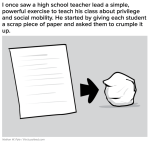
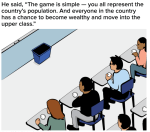
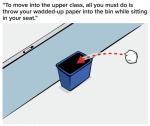
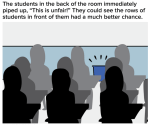
“Your job — as students who are receiving an education — is to be aware of your privilege. And use this particular privilege called “education” to do your best to achieve great things, all the while advocating for those in the rows behind you.”
Looks like this essay was needed, so I went ahead and did it. Not sure I said everything I wanted to say, but I tried.
So, there’s this girl. She’s tragically orphaned and richer than anyone on the planet. Every guy she meets falls in love with her, but in between torrid romances she rejects them all because she dedicated to what is Pure and Good. She has genius level intellect, Olympic-athelete level athletic ability and incredible good looks. She is consumed by terrible angst, but this only makes guys want her more. She has no superhuman abilities, yet she is more competent than her superhuman friends and defeats superhumans with ease. She has unshakably loyal friends and allies, despite the fact she treats them pretty badly. They fear and respect her, and defer to her orders. Everyone is obsessed with her, even her enemies are attracted to her. She can plan ahead for anything and she’s generally right with any conclusion she makes. People who defy her are inevitably wrong.
God, what a Mary Sue.
I just described Batman.
Wish fulfillment characters have been around since the beginning of time. The good guys tend to win, get the girl and have everything fall into place for them. It’s only when women started doing it that it became a problem.
TV Tropes on the origin of Mary Sue:
The prototypical Mary Sue is an original female character in a fanfic who obviously serves as an idealized version of the author mainly for the purpose of Wish Fulfillment.
Notice the strange emphasis on female here. TV Tropes goes on to say that is took a long time for the male counterpart “Marty Stu” to be used. “Most fanfic writers are girls” is given as the reason. So when women dominate a genre, that means people are on close watch, ready to scorn any wish fulfillment they may engage in. This term could only originate if the default was female.
In fact, one of the CONTROVERSIES listed on the TV Tropes page is if a male sue is even possible. That’s right, it’s impossible to have an idealizied male character. Men are already the ideal.
In our culture, male tends to be the default. Women take on the distaff parts. “Him” and “mankind” are what humanity are, “her” and “womankind” are secondary. Yet this isn’t true for Mary Sue as a term. That name was created first. It was a Star Trek fic that coined it and the female desigination was likely a big reason it caught on. This female is name the default to use when describing idealized characters. Marty Stu and Gary Stu are only to be used if you’re discussing men specifically. Heck, there isn’t even an agreed upon term for them. So the only time female can be default is when discussing a badly written character, someone who is more powerful or important or liked than they should be allowed to be, someone the plot focuses on more than you would like, someone you don’t want to read about. Hmmm.
What’s really wrong with a thirteen year old girl having a power fantasy, even if it’s badly written? Who is it hurting? Men have baldly admitted to writing power fantasies and self inserts since the beginning of time. How many nerdy, schlubby guys suddenly become badasses and have hot girls chasing after them in fiction? See: Spiderman- blatant everyman who happens to stumble across amazing powers and catch the eye of a supermodel. Mary Sue is considered the worst insult to throw at a character as it renders them worthless. But since when are idealized characters automatically worthless? Aren’t all heroes idealized in some way? Don’t all heroes represent the author in some way? Aren’t these characters supposed to be people we look up to, people who represent human potential, the goodness that we strive for? Fantasy by nature is idealized, even the tragic ones.
If you look at the TV Tropes page for Mary Sue, it’s ridiculous. You can be a sue for having too many flaws, or not enough, for fixing things or messing things up, for being a hero or a villain. And of course, this is specifically pointed out as a trope related to the Princess and Magical Girl genres- genres aimed towards women are naturally full of Mary Sues. Magical girls are powerful and heroic and actually flaunt femininity as a good thing. They are a power fantasy designed for girls. So of course, a girl using traditionally feminine traits to dominate and triumph means she’s a sickeningly pure Mary Sue who makes everything go their way. Feminine traits are disdained and look down on, so when the positive feminine traits are prominent, the reader has an aversive reaction. How can a character be so feminine and triumph? She must be unrealistic, she must be badly written, because everyone knows it is impossible to be feminine and powerful.
Let’s look at what kinds of Mary Sues people will point to. People will claim a female character is a Mary Sue if she is a love interest. Put a female character within a foot of a male character, and people will scream “Mary Sue!” Why does someone falling in love with her make her a Mary Sue? Well, she hasn’t “earned” this awesome dude character’s love. What has she done to show she’s worthy of him? Fans miss the irony that this line of logic makes the male character seem more like the Sue in Question, as he’s apparently so perfect one has work for his coveted love and praise.
The idea that woman has to “earn” any power, praise, love, or plot prominence is central to Mary Sue. Men do not have to do this, they are naturally assumed to be powerful, central and loveable. That’s why it’s the first thing thrown at a female character- what has she done to be given the same consideration as a male character? Why is she suddenly usurping a male role? “Mary Sue” is the easiest way to dismiss a character. It sounds bad to say “I don’t like this female character. I don’t like that this woman is powerful. I don’t like it when the plot focuses on her. I don’t like that a character I like has affections for her.” But “Mary Sue” is a way to say these things without really saying them. It gives you legitimacy.
If a character is badly written, there’s generally something much more problematic than idealization going on. The plot will be dull and the character will perpetuate harmful stereotypes while other characters act oddly. For instance, Bella Swan is one of the only characters I’d even begin to classify as a Mary Sue, yet it’s not really her supposed Mary Sue traits that bother me. I don’t mind that she gets what she wants and everyone loves her, that she’s Meyer’s power fantasy. What I actually mind is that Stephenie Meyer has her perpetuate harmful anti-woman stereotypes- women need to be protected, women are shallow, women’s worth rests in desirability. That’s what’s actually harmful about her and worth discussing. I would criticize that rather than even get to the fact Bella got to be “too perfect and powerful”- that’s just a tiny, insignificant thing not worth mentioning in a huge pile of problems.
And that’s why I don’t call characters Mary Sue anymore. There’s really nothing bad about a power fantasy or wish fulfillment. It’s what’s fiction’s about. If one of my characters is called a Sue, I’ll proudly say “yep”, because that must mean that she broke out of that box a female character is supposed to be in. So I’ll go and say it: I love me some Mary Sues.
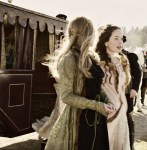
Let’s talk about how, when the war ends, when the Pevensie children go back to London, Susan sees a young woman standing at the train platform, weeping, waving.
First, Susan thinks civilian; and second, she thinks not much older than me.
Third, Susan thinks Mother.
They surge off the train, into their parents’ arms, laughing, embracing. Around them, the train platform is full of reunions (in her life, trains will give so much to Susan, and take so much away).
Over her mother’s shoulders, Susan sees Peter step solemnly back from his father so that Edmund can swoop in to get his hair paternally ruffled. She meets Peter’s eyes across the space, the way they saw each other over battlefields and tents full of the wounded, in negotiations and formal envoys.
She has always seen Peter when others only saw the king, only duty embodied in a young man’s slight, noble features. Susan can see him now, the way he looks at their father. Once, parents had meant protection, authority, solidity. But Peter’s shoulders are slender, are steady, will be weighed down every moment of the rest of his life. She can see it in him, the unreasonable hopes he had that as mighty a figure as a father might take some of that weight from him.
Their father has one hand on Lucy’s round cheek and he is weeping, for all he is pretending not to. He’s a good man, a portly one, thinner than when they left, but Susan can see the loss in the slope of Peter’s shoulders. This good man cannot lighten the king’s load; he only adds one more responsibility to the towering pile. Susan crosses the space to take Peter’s hand. He inhales and straightens his spine.
“You’ve all grown so much,” their mother says.
Edmund is too young to register, but older now than he was at his first war; Lucy, who had been so young when they had left, grew into herself in a world filled with magic. All of them, they have responsibility pressed into their shoulders, old ropes they can’t even grasp for. No one is asking them to take that mantle on their shoulders, and that’s the hardest part. You get used to the weight. You build your world around it, build your identity into the crooks and crannies of the load you carry.
Can we talk about how much the gossipy young girls who cluster in the schoolyard must feel like children to her? And Susan has forgotten about being a child. She is the blessed, the chosen, the promised. Susan has decades on them, wars, loss and betrayal, victory and growing fields, the trust of her subjects. It was a visceral thing, to have all those lives under her protection and to know that her subjects slept safe, peacefully, on dark nights. Here, on this drab concrete, her people are untouchable, indefensible; her self is vanished, her kingdom gone; she can feel the loss like a wound. She has lost her power, but that trust, that responsibility remains. It circles her ankles, trips her in the school hallways.
She barely speaks to her schoolmates. The first few years back, guilt lives in her shaking hands.
For a long time Susan doesn’t want to be tied down to anything (she doesn’t want anything tied down to her, because she has, it seems, a pattern of disappearing). Peter pours himself into schoolwork and extracurriculars. He wakes and works, excels in his steady way, like he owes someone something.
Lucy befriends wayward girls like they were shy dryads, sly naiads. Lucy walks the playground with all the bright, sprightly grace of a girl who could find worlds in the backs of wardrobes, and she finds smiles in schoolgirls, finds enough of herself to give away.
Lucy gives faith, Susan gives effort, time, work—there are many differences between them, these two sister queens, but this was one. But for a long time, after they return, Susan doesn’t give anything. She is a queen who has abandoned her kingdom and she feels that in the very bend of her spine. She will build no more kingdoms, she swears. Her shoulders ache under the weight of a responsibility she will never lose and now can never answer to.
It is Edmund, of all of them, who understands. He is the other who gets angry, for all he holds it in these days. He is Edmund the Just, after all, and weighs each word before he says it. She is Susan the Gentle, because she will give, will build; because where Peter is elevated by duty, she carries responsibility in soft hands, on worn shoulders, pours all she has into it.
It is Lucy who makes things more than they are. Girls are dryads and bullies are the cruel kind of wolf. Trees dance and every roar of a city bus is a hallo from a lion who is not tame. That is Lucy’s battle and she is as glorious as her sunrises. It would kill Susan to live her life strung between two worlds. They go on walks together, Lucy and her effortless blaze, Susan’s quiet sturdy stride. Lucy sings, but Susan watches; the trees do not dance. The trees are only trees.
A boy pulls at a girl’s pigtails across the schoolyard, yanks at the bow on the back of her dress. Susan sees a bully and she marches forward as a friend, a foe, a young woman furious and proud, a kingdomless queen. Susan draws herself up, the scant inches of height she will some day supplement with heels her siblings will scoff at. Dripping majesty, she moves across the ground (crowds part in her wake), and steps between the girl and the bully.
Let’s talk about how Susan was reading a book the day they went through the wardrobe; how she found it sitting, neatly bookmarked, beside her bed the day they came back. Her arms still felt clumsy then, her legs too short but also too gangly. She kept thinking about white stags, about if her mare got home safe, after, about the meetings she had lined up for the next week with the beavers, the heraldic university, the stonecutters’ union. She had paperwork on her desk she had meant to get to, petitions and letters from faun children who wanted to come on a field trip to Cair Paravel.
Susan had this waiting for her here, left out on her little bedside table: a penny and dime novel about a schoolgirl romance, half-read. Susan sat down on the twin mattress and took it in her hands. She remembered buying this, faintly (it had been years now; weeks before they boarded the train for the country, years from this weary shaking moment). She had wanted a detective mystery, but this had seemed more appropriate and she hadn’t wanted to look odd at the cash register.
At school, Susan sees a girl in mathematics who looks like a dryad, willowy limbs and distracted eyes. Where is your tree? Susan wants to ask. Is it safe? Is it blooming? She would fight to keep her safe, talk to her guards, go out on diplomatic missions, negotiate with the local woodcutters.
There’s a girl in the back row, shy, steady, who takes the best and swiftest notes in her very own shorthand. Susan finds herself wanting to recruit her for the Narnian scribe service. She shakes herself, but she approaches the girl after class anyway. Susan reads through wanted ads and helps the girl send out applications for internships.
Or another young woman; this one blazes bright, drawing people in her wake as she chases after efforts for raising money for a new library wing or cleaning up some local empty lot for the children. This girl laughs, shakes her mane of hair, and Susan wants to take her under her wing and teach her how to roar.
“Edmund is so solemn,” says her mother, worried, to Susan. “Is he alright? And Lucy seems even less…” Her mother hesitates, chewing a lip.
“Present,” Susan offers, because Lucy still has a foot in Narnia the way none of the rest of them do. Peter still holds the weight of his crown, certainly, and Edmund the load of his mistakes. Susan has the faded ink-stains of a hundred missives, orders, treaties, and promises she never got to send. (She wakes now, some nights, full of nerves for a formal audience the next morning, and remembers it is just a literature presentation. She feels relieved and useless).
But Lucy, Lucy walks in light. She dreams of dryads and when she closes her eyes she can hear them dancing in the wind on the upper boughs of the trees in the garden.
It is a stubborn faith, a steady one, harsh even. Lucy clings to things with two small hands that remember having calluses from reins, remember holding hands with dryads and dancing in the moonlight, remember running though a lion’s wild mane. Lucy grins (it is a defiance, not a grace, not a gift); she bares her teeth and goes dancing at midnight under trees that creak in a storm’s gale (she gets a cold and misses a week of school, for that). Lucy will believe until the end of the world, burning with that effortless faith.
This is not effortless. “Such a happy child,” their mother says of Lucy, sighing relief, glancing uneasily at Edmund. Susan is not a happy child, but she is not meant to be. She is their stability, their quiet, the little, gentle mother, the nursemaid wise beyond her years. No one looks. They rely, and it makes Susan want to scream.
“Luce?” said Edmund. “Happy? I suppose. She’s more a fighter than any of us.”
Lucy gets up early in the mornings and goes outside to watch the sunrise while she eats her toast. Susan is jealous of her ease, for years; an early riser, a morning person, effortlessly romantic. There are days, when Susan is angry at schoolteachers, or missing her seneschal’s dry wit, days when Susan cannot find even the most glorious sunset to be anything more than just glaring light in her tired eyes. But Lucy, no, every day Lucy watches the sun rise and lets that fill her. Easy thinks Susan, jealous, and she is wrong.
It is not for years that she realizes how much effort is tucked into Lucy’s bright smiles. The joy is not a lie, the faith is not contrived, but it is built. Lucy pulls herself out of bed each morning. She watches the fires of the day climb and conquer the sky, and dares her world to be anything less than magical.
Susan tired of bullies before she and her siblings had even finished with the White Witch’s defeat. She will stand it no more in this world than she had in Narnia. For the cruelest bullies: she digs up their weakness, their secrets, and holds them hostage. The misled, the hurting, she approaches sidelong, with all the grace of a wise ruler, a diplomat’s best subtle words against a foreign agitator with borders along an important trade route. The followers she sweeps past, gathers up, binds to her own loyalties. They may be allowed to become her fine guard if they deign to learn kindness, or at least respect.
Susan joins the newspaper because extracurriculars look good, and if she is going to live in this world she is going to do it well. She finds she likes it. She rubs ink into her palms and feels almost at home. She hunts down quaint little school stories overzealously, like the detectives in the novels stacked by her bed, like a queen hunting down secrets at her court.
(Lucy contributes poetry to the arts section of the paper. Susan only reads them on weeks she is feeling brave, because, like all of Lucy, her poetry picks you up and takes you away).
When Susan wakes up, these nights, dreaming of ink on her fingers, she doesn’t expect to find her desk at Cair Paravel. Or, when she does, she squeezes her eyes open and looks around at the newspaper room on submission night. The copy editor fumes quietly, a writer hyperventilates in a corner, another clatters away. An editor coaxes into the telephone, talking with their printer, negotiating for time. It is not quite a council of war, but it is hers. It is not quite a kingdom, but Susan’s still a child, after all. She has time to grow into this skin.
When Caspian’s horn calls them home, the Pevensies stand in the ruin of their palace. Thick, old trees, not saplings, not young wildflowers, grow over the graves of the petitioners Susan had never gotten to meet with, of the children who had written her letters in careful, blocky handwriting. When I grow up I want to be as beautiful as you.
Susan, standing in ankle deep grass on the cracked flagstones of the home she had spent most of her life in, has the gangly, growing limbs of an adolescent. A horn’s call (her horn) is ringing in her bones, centuries too late. That call has always been ringing in her, really, shaking her hands, reverberating her lungs, since the day a queen tumbled back through a wardrobe and into a life she hadn’t missed.
Susan stands under a mound, in the ruins of a castle, on a battlefield. Her Narnia has grown out of itself, grown into itself; her subjects are gone, but there is an army at her feet who trusts her. She left, but they did not lose faith. Susan does not feel absolved. She feels guiltier than ever, to know they kept faith she didn’t deserve. She wonders if this is how Aslan feels about Lucy.
The very shape of the land has changed. Mounds stand over old broken tables and rivers have become deep chasms. Her body is the body of a growing child, and her heart is that of a widow twice over.
When Susan leaves Narnia for the last time, she steps back into a world where she has ten articles to review by Monday, an essay due the next week, and a mathematics test on Friday. She has dishes to do and Lucy to keep an eye on. She wants to weep for days, but instead she goes home, plucks a detective novel off her bedside table, and tries to remember where she left off.
Susan doesn’t cry, but she hardly sleeps. That call is still humming in her bones (it always will, even when she learns to call it by other names). Susan snaps at her lioness, her dryad, her scribe; her bully boys flee at her short temper. One of her friends finally takes her aside. “What’s going on, Su? You can tell me.”
She forgot people could give you kindnesses back. “I lost something important,” Susan says, and the tears finally start to fall.
She weeps into her friend’s shoulder while she murmurs comforting things. “I’m right here.”
You are, Susan thinks. And so am I.
There is wind in the treetops. They are only trees.
Susan was the chosen, the blessed, the promised. She does not want to be promised. She wants to promise, instead, to take the hands of brave friends and try to build something new.
The only thing that will compare to this grief will happen years later, a train crash, a phone call to her flat to tell the awful news to the next of kin. Now, losing Narnia, these four are the only ones here who will remember that world. There is a loss in that. There is a fragility in that which terrifies.
After the crash, Susan will be the only one left to remember them.
Maybe it was a shunning and maybe it was a mercy, to leave Susan to grow old. She had had too many kingdoms ripped from her aching fingers to be willing to lose this one, so instead everything else she had was taken away.
Maybe it was an apology. Maybe a lion could better understand mourning the loss of a kingdom than the loss of siblings. Maybe he thought he was being kind.
As Susan grows, her schoolmates stay in touch, young girls who grew in her shadows or strode in blazing light before her (both are strengths), the ones who walked with her and learned majesty from her older bones. She gets letters from her bullies, too, the ones she subverted through threats or kindnesses. Some are fathers, railway operators, preachers, bookshop cashiers. Her girls are mothers, some, or running libraries, charities, businesses from behind the throne; one is a butcher’s apprentice of all things, another battling her way towards a Ph.D.
One married a farmer’s boy with a warm smile and moved out into the country. Susan goes out to visit and they go walking through her fields and little copses of trees. The trees are only trees, and some of Susan’s heart will always break for that, but she watches her friend’s glowing face as she marks out the edges of her land, speaks with her hands. The trees are only trees, but they are hers.
Susan goes home by train, the country whisking by outside. She pours over notes, sketching article outlines in her notebook, deadlines humming in the back of her mind. Her pen flicks over the paper, her fingers stained with ink. This is hers.
Years later, Susan digs up old copies of her school papers. She goes through them, one by one, and reads each of Lucy’s poems.
Cross-legged on the floor, she cries, ugly sobs torn out of her, offered out to ghosts of sisters and brothers, parents, Narnian children grown old and buried under ancient trees, without her. Lucy’s poems take her away (they always do) and leave her weeping on her living room floor in her stockings.
Susan stacks the papers neatly, makes herself a mug of tea and goes outside. The trees are only trees. This is a curse. This is a blessing. She breathes deep.
Peter was the only one who understood as well as she did what it was to be the rock of other people’s worlds. She remembers Edmund every time rage swells in her stomach, every time she swallows that rage down and listens anyway.
On early mornings Susan rolls out of bed, all groans and grumbles, and scribbles down a thought or two about her latest article if anything percolated during the night. She does her make-up on her apartment’s little balcony. Susan watches the rising sun light the sky and dares her life to be anything other than hers.
For now, I’m using the term PoC (people of color) as a shorthand, understanding that it refers to people in white-majority cultures and can’t describe white-minority cultures, for ease of writing, but also because I will largely discuss diaspora.
First, let’s discuss the issue of terminology and identity. “Asexual” is a difficult term for PoC to use. We are made hypersexual (e.g. stereotypes of Black women as very sexual) and asexual (e.g. Asian men being treated as alien, sexually dysfunctional; the Mammy trope). The term “asexual” is often actually used in these contexts. Even when it isn’t, to attach “asexual” to our identity means navigating a really complex, terrible issue where PoC bodies are regulated and controlled because of racist views of our “asexuality.” Sterilization programs that target minority women are realities in the US and other nations with racial minorities, while the simultaneous “aging up” of Black children and assumed asexuality means they are treated as sexually passive, and so often are targeted in sexual crimes. This sort of “de-sexing” has been a form to control PoC/especially Black women’s agency since slavery.
Siggy writes (1):
“Stereotypically, Asian women are hypersexualized and Asian men are desexualized. Each of these come with their own set of issues for asexuals. Asian asexual women might be disbelieved because they conflict with the stereotype. Asian asexual men might be assumed to conform to the stereotype completely, even if the stereotype is actually very different from asexuality in real life. Also, sometimes people say Asian men are stereotypically asexual, which is bad because it’s using the word "asexual” as a pejorative.“
With regards to the challenges Black women face, voltafiish writes (2):
"While asexuality has not had such a long history, the majority of its representation in the media has been overwhelmingly white. Asexuality is seen as a “white thing” too! For asexuality in black people (especially black women) from the outside looking in can be broken down into a few categories:
A) Asexuality functions as a white supremacist stereotype. This means asexual black person is not actually asexual, but simply a desexualized black person (like the mammy, for example) or they are simply suppressing their “true sexuality” in light of other racial stereotypes (like the jezebel). Of course, these are dependent on an inaccurate definition on what asexuality is but contrary to a lot of activism, a lot of people are still fixed on using this definition. Because people do not know what asexuality is, their first assumption is one that equates behaviour and attraction.
B) Asexuality cannot possibly BE a thing because black people MUST be sexual by “nature.” This is due to the myth and stereotyping and labeling of black people as hypersexual. If we operate on the definition on asexuality being about not having sex/being sexual and operate within the realms of white supremacy, black asexual people cannot exist. I remember looking up research concerning blackness and asexuality and came across someone make the very same statement: “Black people cannot be asexual because they are hypersexual.”
C) Asexuality (and any other sexuality for that fact) is not possible for black people because all black people are heterosexual. Cue compulsory heterosexuality.”
As you can see, not only does the concept raise issues for PoC self-identifying, but for those who identify as asexual but must, again, navigate larger issues.
GradientLair writes (3):
"If I tell anyone that I am 34 years old and I’ve been celibate for a little more than 8 years now, they look at my Black skin and female body and the judgment starts. Because I am a Black woman, I am automatically typed as heterosexual but “deviant” (as “normal” heterosexuality is reserved for Whites in a White supremacist society) and “hypersexual” (based on the long history of specifically anti-Black misogyny used to justify the rape, exploitation, lynching and dehumanization of Black women’s bodies and lives). Any sexuality that I ascribe to that is not heterosexual and hypersexual is deemed as me sidestepping the “norm.” However, this White supremacist lie is not the norm or even remotely explains the complexity of sexuality for any people, especially Black people because of our history.”
I recommend if you are unfamiliar with some of the issues she discusses, to click through and then explore her embedded hyperlinks. Meanwhile, queerlibido/Alok Vaid-Menon discusses issues of intersection with respect to the South Asian male identity (4):
“As a queer South Asian I don’t feel comfortable ascribing the identity of ‘asexual’ to my body. Part of the ways in which brown men have been oppressed in the Western world is by de-emasculating them and de-sexualizing them (check out David Eng’s book Racial Castration). What then would it mean for me to identify as an ‘asexual?’ What would this agency look like in a climate of white supremacy? Can I ever authentically express ‘my’ (a)sexuality or am I always rehearsing colonial logics? The dilemma of this brown queer body is its inability to see itself through its own eyes. The mirror becomes a site it which we view what white people have always told us about ourselves. Regardless or not of the status of my libido, I’m not sure I will ever feel comfortable identifying as asexual because it seems like I am betraying my people.
I am invested in South Asians and all other Asian Americans being able to reclaim, re-affirm, and be recognized for their sexual selves. I am invested in brown boys and brown gurlz being able to get what they desire. I am invested in the radical potential of brown (queer) love in a society where so many of us grow up hating our bodies and bending our knees for white men. I want to be part of this struggle. Sometimes I get angry at myself for not being able to eliminate the distance, not being able to join in solidarity. To fuck and be fucked, to publically claim and own my sexuality. I understand that there is something (as Celine Shimizu reminds us in her book Straightjacket Sexualities) radical about Asian American masculinities being displaced from patriarchal masculinities rooted in hyper-sexuality and hyper-masculinity and the reclamation of ‘effeminate’ and ‘asexual’ representations of our bodies as a political refusal of the very logics which have rendered those bodies numb.
…
So when I read this piece about how folks involved with the asexuality community feel as if they are post-race I’m pretty well, flabbergasted. Asexuality has always been a carefully crafted strategy to subjugate Asian masculinities. Asexuality has everything to do with race. Which goes to say that what if the very act of articulating a public asexual identity is rooted in white privilege? Essential understandings of being ‘born’ ‘asexual’ and loving my ‘asexual’ self will never make sense to me. In a world that continually erases Asian (male assigned) sexualities I was coerced into asexuality. It is something I have and will continue to struggle with. My asexuality is a site of racial trauma. I want that sadness, that loss, that anxiety to be a part of asexuality politics. I don’t want to be proud or affirmed – I want to have a serious conversation about how all of our desires are mediated by racism and how violent that is. My pleasures – or lack thereof – are not transcendental and celebratory, they are contradictory, confused, and hurt.”
He cites an interview on AsexualAgenda (5), excerpted here:
"Often, white asexuals and those who do not identify themselves use these threads to make statements that, 1) AVEN is a safe, diverse environment, 2) AVEN is a race neutral place and asexuals are color-blind, or 3) race is anarchronistic, un-important or itself “racist.” All three of these tendencies work to minimize the significance of race, to obscure “white” as a race by claiming neutrality, and to dismiss user interests or lived/digital experiences.”
So now we arrive at issues within the community and how it treats PoC and the diversity of the ability for aces to identify as such. A good place to start is the “crux” of the community – AVEN – where we can see, in often popular threads, blatant racism.
A thread discussing World Pride 2013 and whether PoC aces should have a separate space:
AVEN forum search for keyword “racism” (6):
The AVEN thread “AVEN has traumatized me” (TW for sexual assault/rape/victim blaming) also brings up how often AVEN members come across racism in the forums and are unable to report it (7). The AVEN thread “Asexual People of Color” has many a post on the grievances aces of color face with their identities and on AVEN (8).
As we can see, there is an issue with racism, talking over PoC, and treating racism as a nonexistent issue, or else race itself as a nonfactor in asexuality and sexuality in general. But these issues are not limited to AVEN, which many identify as a generally problematic space and have thus abandoned for spaces like Tumblr. Here, and in similar spaces, the racism has been more subtle, and it is where I see the sweeping issue of racism in our representation, dialogues, and activism.
The faces of the asexual movement – and by “asexual movement,” I use a term and definition as employed by David Jay and his followers – have been exceedingly white. A simple example:
How popular was this image? Has it changed at all? Siggy writes again, two years ago (10):
“And yet, the publicly visible asexuals are disproportionately white. An asexual who was Asian asked me the other day if there were any non-white asexuals I knew of, and was clearly disappointed when I could only think of a few. This is both indicative of, and a contributor to greater asexual invisibility within API and other non-white groups.
And here I am, contributing to the problem even further. I decided it was less worthwhile to present asexuality to an API audience than to a “general” (but probably predominantly White) audience. I was further tipping the already imbalanced scales. If all asexual activists did the same, it would become a major problem a decade down the road.”
Because, really, let’s look at who goes on talk shows, interviews with newspapers and magazines, and gets photographed. Who do we see associated with articles on asexuality, like HuffPost’s series?:
Some must wonder now if it’s that whiteness and white culture allows for greater visibility when it comes to queer identities. But is this true? What about the history of queer Black artists (musicians, visual artists, dancers, writers) and their precedence of very public activism? Because I say that the lack of brown and black faces in the public, representing us, cannot be completely chalked up to cultural differences. When I look at canonically asexual characters (or…attempted asexual characters), I see white faces – in fiction, where writers look at our community and try to create fictional characters, or else ace writers create these fictional characters. Sirens, House, Huge, Ignition Zero, Girls with Slingshots, Quicksilver all have canonically (or attempted) asexual characters that are white, and even articles/essays that seek to analyze the media where we find these characters will not bring up the race question a single time (11). These data can only reflect the community and the visible, un-erased members of the community – because not all of these authors are outsiders.
I also want to talk about how aces of color are cordoned off when it comes to dialogue. This is an especially subtle aspect of the community that I have noticed for a few years – where writers who discuss the intersection of race and asexuality are largely written off by the community as irrelevant to net community politics. For example, GradientLair’s posts almost never make the rounds of the tags or forums, except for black aces, as if white aces and non-Black aces of color have nothing to learn from an asexual Black woman’s important perspective on sexual politics.
There are two effects I observe from this habit. First, aces of color feel pushed out because their voices are not heard, or else they face racism as evidenced above in AVEN. Second, what is established is whiteness as the norm – PoC voices are, even if not actively, made an “other,” or a “niche,” and if these posts do make the rounds, they are not discussed, but tagged lazily with “intersectionality” or “boost” to be passed along for followers of color. PoC are made to feel like we are a separate cause and the nuances of our identities have no effect on the asexual community, where “asexual community” is thus equated with “white asexual voices.”
An example of this harm is the recent backlash against sex positivity rhetoric among the ace community. There is no harm in such dialogue, but what I find especially interesting is how aces, including prominent asexual activists who often represent the community publicly, have taken credit for spear-heading the critique of the sex-positive movement. As I’ve cited above, Black women in the West have traditionally been targeted sexually because of their race and as an effect of slavery – Womanism, therefore, has traditionally involved critical analysis of compulsory heterosexuality for decades. I recently began to compile a list of sources by mostly Womanists because of this strange trend among white aces (12). This type of irresponsibility and co-opting is exceptionally harmful to Black women and Black aces, who already face massive erasure, and furthermore it is distressing that leaders in the community propagate these attitudes in a largely white community.
In sum:
the community ignores or dismisses race as a factor in sexuality
blatant racism occurs in the community
aces of color do not get any visibility in the media
the issues aces of color face at the intersection of many identities are deemed irrelevant to the “broader” community, and so the community is equated with whiteness, and co-opting of QWoC dialogue occurs on a large scale
I want to wrap this response up here, because I think this information is sufficient enough to convince those willing to learn that racism is very much rampant in the asexual community, and that aces of color find it difficult to find a space in it as it exists currently. This post is not for those who refuse to teach themselves. You are the problem, not just those who merely don’t know what’s happening around them because of their privilege. I urge those of you in this latter group to recognize your privilege, end this Othering of PoC, challenge the presumed “normality” of the whiteness in our spaces, and magnify the voices of people of color around you. It is not tokenizing to stop erasing, and it’s not an attack on you to notice, let alone speak up.
Remember: being an ally is not about posting a political alignment on Facebook or any social equivalent. It means knowing that you will not be attacked for speaking up about a certain issue (ergo, you have privilege), and employing that power to protect and defend those of us who are vulnerable. Because we are vulnerable. I have personally received hate/abuse for even mentioning race in this space and offline spaces, and have been building up the courage for four years to discuss these issues on such a public blog, so please understand that I am not exaggerating.
70% of anti-LGBTQ murder victims are PoC (13). 87% of hate murder victims in 2011 were QPoC (14). TPoC statistics reveal even more – and make sure to go through this whole study (15):
This isn’t fun and games, or petty complaints on a website. This is survival.
















 Kirkwall Was Totally Built On a Hellmouth