When I went into the store today after work, I had decided I was going to be brave. I had a pretty good day, and I wanted to reward myself with something I’d been eyeing for quite some time. Mens underwear.
I won’t lie, I stalled quite a bit before I slunk over to the mens underwear section, but eventually I wound up in the aisle looking over my various options. It was while I was trying to figure out what size I would be, that the man is all his socks and sandals glory came into the aisle. I barely had time to look up before he bellowed at me, “you fucking abomination”
I gaped like a fish while I tried to wrap my mind around the fact that yes, this was happening, and yes, he just yelled that at me. He said it again, and began to make his way towards me, very tall and very angry looking. All the clever things I wanted to say died in my throat and tears started pooling in my eyes.
Just as he was getting right up in my face, telling me about how there wasn’t a single god from any religion that would accept a piece of shit like me, you appeared at the end of the aisle. You ran towards us and put yourself between me and him like you weren’t a tiny 5 ft nothing. Then you stuck your finger in his face and told him to “shut the hole in his head that was spewing ignorance and hatred and get out because he wasn’t welcome here”. It was his turn to be the fish then, and before he could say another thing you shouted “GET THE FUCK AWAY” drawing the attention of shoppers who had been so conveniently hard of hearing before. He tucked tail and left.
You turned to me then, put the underwear I had dropped back in my hand and asked if I was okay. I was sobbing and could feel my face doing the ugly thing it does when I cry. I nodded, you asked me if there was anything else I wanted to look at in the mens section, I shook my head. You asked if I had anymore shopping to do. I huffed out that I wanted some bananas. You took my hand and lead me towards produce. You told me I was beautiful. You told me I would look so handsome in the underwear I picked. You helped me pick out bananas and told me my future was so bright and wonderful it was practically blinding.
You held my hand all the way to the cashier, and then outside. You asked me if I wanted a ride, I told you I’d like to walk, that I needed some time to cry. You stared at me very seriously, then hugged me so hard I could feel all me pieces coming back together. You said “I don’t even know who you are and I don’t care, I love you”
I cried all the way back home.
Thank you. Thank you for everything. For who you are, and for what you did. Plenty of other people passed by and did nothing, but you came in like a shining beacon and all I can say is thank you. You saved me when I was all alone. Thank you.
Look, when I say “representation matters,” I believe that the most important thing is for people who are often ignored in arts and media to see themselves there.
But I also mean that it’s important for white/hetero people to see people who aren’t white/hetero.
Here’s the thing. I was raised in a very white/hetero community. Every friend I had was white. I never had a black person in my classroom until late high school. I never had a black teacher until college. There was one out-gay student at my high school. One. And I saw what shit he had to go through by being out.
And, if I’m honest with myself, most of the adults in my life were racist and homophobic. They were good, loving people…to me. But they were also racist and homophobic.
And as a kid through my teen years, I’d be lying if I didn’t say that didn’t affect me. I parrotted the adults in my life, which meant that I often parrotted their hate and their prejudice. I’m ashamed of those attitudes now–now that I’ve had education and met people who were different from me and travelled the world and put aside hate.
But then? It was easy to excuse racism. People who weren’t white and straight didn’t exist in my world–and they didn’t exist in the world I saw on television and in books and on the radio. It was easier to live in the bubble of that world.
Representation matters to white people, too. It is important for white people to see diversity. Not as a token, not as “politically correct”–the white people who feel that adding a minority character to a storyline is pandering are horrible people who are entirely missing the point. I’m talking about the white kids who don’t see minorities in their lives, but who see a black girl and a white boy being friends on Sesame Street. I’m talking about the straight teen reading More Happy than Not, I’m talking about the white teen empathizing with Malala Yousafzai. The more representation we have, the more we hold a mirror through the world rather than whiting-out people who aren’t like the majority, the better our world is.
Representation matters.
I swear to god, it’s like every damn word could have come out of my own brain. Brava!
Honestly. As someone who went to a very tiny, almost completely white private school through eighth grade and then to a high school in a city with the demographics of a marvel movie (89.3% White, 0.7%African American, 0.4% Native American, 5.6% Asian, 0.2% Pacific Islander, 0.8% other races, 3.0% two or more races. 3.7% Hispanic or Latino) I never realised that the casting choices in most tv shows and movies vastly underrepresent any race that isn’t white.
I remember being confused about people saying they should hire more actors of color for movies set in like new york because thats what i legit thought the rest of the US and western europe was like.
Representation matters more than you think.
If whiney white boys would have grown up in a world where other races (and genders) were represented in their media from a young age, they wouldn’t be flipping their shit every two minutes cos there is a chick lead character or POC in a previously white role. Representation trains little white boys not to be douchecanoes.
Love when there are “how to tell if someone is lying/manipulating you” posts on my dash and 90% of them are things I do as an autistic person
Stuff like not making eye contact, wringing my hands, having a closed-off posture, having to control the tone of my voice, preferring to talk over the Internet… The whole damn list is just a huge presumption that if you don’t act “normal” then you’re lying
Like… Buddy. My whole childhood I got in trouble for things I didn’t do because I couldn’t make eye contact and I laughed at inappropriate times because that’s how my body decided to deal with fear. It wasn’t the greatest tbh
Although can we have a thing where a ~great detective~ accuses someone of being a murderer based on body language during an interrogation and then they’re like “I’m autistic, you fuck. This is just what I do! …Nice work being ableist and letting the real killer get away btw”
^^^This is so important. And as a criminologist, let me also add that body language is actually a TERRIBLE indicator of truth telling & deception.
Unfortunately, all of the research shows that using nonverbal behavior when trying to detect deception is not very useful.
If you doubt that claim, please see what all of the leading experts on the topic have to say (see Science News).
And using technology to detect deception isn’t as useful as people think it is (see ScienceDaily Report).
Why is it so difficult to detect deception by watching a person’s nonverbal behavior?
A detailed explanation is provided below or you can skip ahead to the next page and read why it is even more difficult to detect deception by a loved one (next page, catching lovers lying).
To begin with, there is some truth to the idea that people display or “leak” their genuine feelings when lying. But, these genuine displays of emotion—called “micro expressions"—last only a fraction of a second. As such, these expressions are too brief to be of much practical use (see facial expression test).
Furthermore, the nonverbal cues identified represent “on average” what might happen when studying many individuals rather than identifying what any specific individual is likely to do.
For instance, imagine that you have a group of 1000 men and a group of 1000 women, and you know that, on average, the men are 2 inches taller than the women. Now, say you find out that someone is 5’9”. Based on that information alone, can you tell with any certainty, if the individual in question is a man or a woman?
Why not?
The problem with “averages” is that it is difficult to use the information obtained from a large group to make claims back to any specific individual without a lot of other information. After all, there are tall women, short men and everything in-between. So, knowing someone’s height, by itself, does not really help solve the problem of trying to figure out if any given individual is a man or a woman (see Truth, Lies and Romance—provides a detailed example of this type of problem).
Second, the nonverbal cues that have been found are based on small statistical patterns—they are not strong, informative (diagnostic) differences.
This time, pretend that you have a large group of men and a large group of women. But, now the average height difference between the two groups is very small—say less than an half an inch. That half an inch may still be a statistical difference, but because the difference is so small, it is even less useful when trying to guess someone’s sex just by knowing how tall they are.
This is the same problem that occurs when using nonverbal cues to detect deception. The cues represent small, statistical differences between two groups rather information that can be used the other way around; that is, to distinguish liars from ts.
For example, some studies show that liars blink a few more times on average than truth-tellers (and not every study shows this). Now, say you notice that someone blinks several times while talking to you? Are they telling the truth or not? Who knows? To begin with, both liars and truth-tellers blink when talking (you are probably blinking right now)… And some liars rarely blink while some truth-tellers blink a lot… The graphs below show why the differences obtain are of little use when trying to detect deception…
Differences in Blinking Between Truth-tellers and Liars
So, in any given situation anything might happen, and the nonverbal cues that have been found ONLY emerge when looking at group averages.
Long story short, because only small statistical differences in detection cues have been discovered. It is very difficult to identify group members (liars versus truth-tellers) based on the cues that have been identified.
Most people, however, do not believe this claim.
Most people believe that nonverbal behavior can be used to detect deception. But, all the research shows that people no better than “flipping a coin” when trying to detect deception, especially when it comes to love and romance (see Miller & Stiff).
The nonverbal cues that have been identified are not useful because truth-tellers and liars are more similar in their behavior than they are different. And there are many reasons why the nonverbal differences identified are so small and of little practical use (see Fielder & Walka; McCornack).
First, many of the lies that people tell come naturally with no planning, thought, or effort. Lying is often automatic and effortless. Most people are not even aware of the fact that they are lying when they do it. Deception can come across as being “natural” because for many people it is natural.
Second, even if there is some stress or anxiety present when people lie—people typically tell the same lies over and over. Accordingly, people become very comfortable with their lies as time passes. In fact, people tell the same lies so often that they actually begin to believe what they are saying.
Finally, telling the truth can sometimes be just as difficult and stressful than lying. Have you ever been agitated, confused, anxious, or upset while trying to tell the truth only to have people doubt what you are saying? “High stake” situations are stressful for both liars as well as truth-tellers. In such situations, both liars and truth-tellers can get nervous and give off the appearance of telling a lie.
Or think about the problem this way: if detecting deception were so easy, everyone would do it and there would a lot few problems. Affairs, crime, and fraud are only possible because people, even trained professionals, have a difficult time detecting deception with any degree of success.
And, for the most part, people are even worse at spotting lies when dealing with someone they love… (source)
Sorry for the long response, this just NEEDS to be said & known. I’m very sorry this happens to you @medicationmambo bc it absolutely should NOT *hugs*
*genitals mention tw, rape mention tw, sex mention tw*
I am an Asian cis-WOC who has a lot of frustration with the asexual community.
I’ve written about this elsewhere, but I really need white people – asexual and allosexual – to stop saying that “POC sexual attraction/behavior isn’t privileged" as a way to invalidate asexuals. This implies that asexual POC are thus privileged over allosexual POC, which is very insulting to us. Yes, POC may be judged more harshly for sexualized behavior – for example, Miley Cyrus and Lena Dunham are praised as “feminist” but Beyonce is criticized for being “too sexy” – and everyone should be aware they’re not falling into that trap.
However, hypersexualization and fetishization of POC is driven by racism, not about our sexual attraction or behavior. My features – olive skin, thick dark hair, full lips – are usually portrayed in popular culture as sexy or sensual, not pretty or beautiful or cute. Before I knew I was ace, I had intense self-loathing, particularly for sexualized body parts such as thighs and skin. I still struggle with body hatred because I don’t feel sexual but look that way.
POC bodies, NOT BEHAVIOR, are sexualized and fetishized. Stereotypes about genital size inform stereotypes of black men as hypermasculine and Asian men as effeminate. Even a wealthy, middle aged, married black woman like Michelle Obama has inappropriate media attention paid to her rear end. Asian fetishists are fascinated by rumors that Asian women have sideways vaginas or that we’re “tighter” than other women. Some people even refer to our skin color in food terms. Even when fetishization is not so blatantly anatomical, there are stereotypes about Latinx and Middle Eastern people as “naturally sensual” or Native American and indigenous people as “noble savages,” their bodies providing playgrounds for fulfillment of white sexual fantasies. This has nothing to do with our sexuality, whatever it may be, and everything to do with our race.
White aces, how would you like your race to be a popular porn category, or to have cis-het men associate your race with massage parlors, mail-order brides, and foreign sex tours?*
White people need to understand that asexual POC do not get a free pass out of sexualization and also need to stop exploiting racism to silence or bash aces – some of whom are POC(!)
Lastly, I want to address the rhetoric around sex favorability. I want white aces to think about WOC when they discuss sex favorability, compromise, and “aces can have sex too!!!!!” It is not ok to promote asexual sexual availability without also promoting asexual sexual agency.
Too often allosexuals hear “aces can have sex too!!!!” and assume that since we don’t feel sexual attraction (one definition), sex doesn’t mean anything to us, and therefore we’ll eagerly comply with their desires. I have seen them happily suggest that sex means about as much to us as eating pie, or that we do it as a chore to keep our allosexual partners happy. (Fine if you do, but this doesn’t apply to most asexuals – I suspect that most sex-enjoying asexuals enjoy it only under certain circumstances, and many of us don’t care for it at all.)
WOC are already hypersexualized, denied sexual agency due to our race and gender, and may be sought out for specifically sexual reasons (it’s harder to spot than you think, racial fetishists may deny it, or not be upfront/obvious). We don’t need another reason for people to assume our sexual availability. If the asexual community really wants to support aces of color, particularly ace WOC,** we need stop the unqualified “aces can have sex” line and instead insist that asexuals have the right to completely opt out of sex (as most of us will) or to freely choose to have it on our own terms.
*White people, now is not the time to call me “wh*rephobic” or SWERF. My problem here is not with women in the sex industry (or mail order brides for that matter), but men associating Asian women with sexual availability. This happens with other WOC too. It is racist because 1.) it generalizes about an entire racial group of women, and 2.) WOC and women from non-Western countries are overrepresented in the sex industry due to the socioeconomic effects of institutionalized racism, colonialism and exploitation. Given that men, including johns, commit the overwhelming majority of physical and sexual violence against sex workers, and that many think it’s ok to coerce or mistreat sex workers (example, assuming exotic dancers will also offer sex or sexually assaulting them), I don’t think it’s “wh*rephobic” for me to fear for my safety if a cis-het male stranger assumes I’m a sex worker.
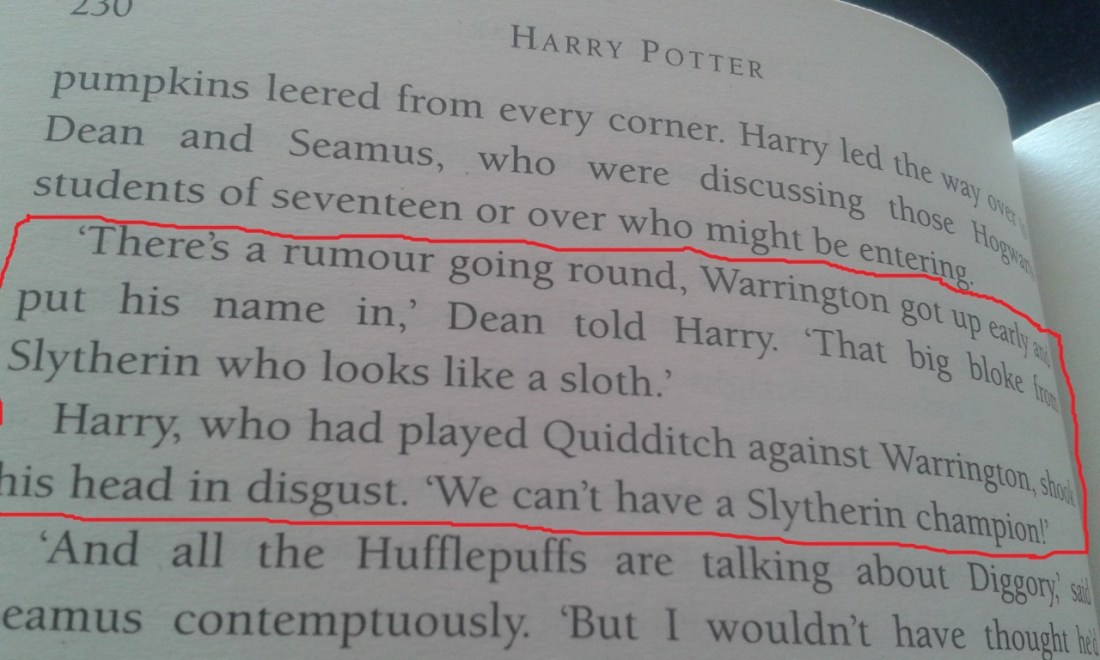
So I was rereading Harry Potter, when I came across this and thought- what if instead of Cedric Diggory, Cassius Warrington had been chosen to compete in the Triwizard Tournament?
Imagine Dumbledore calling out the name of the Hogwarts champion and it isn’t a Gryffindor, or a Ravenclaw, or even a Hufflepuff, but it’s a Slytherin. A student from a House most people hate.
Imagine Cassius Warrington getting up, and three out of four Houses are booing at him and shouting things like “NO!” or, “We can’t have a Slytherin champion!” or demanding a retry. But he’s a Slytherin- he’s been dealing with this shit since he got sorted, so he keeps his head high and joins the other champions.
Imagine Harry trying to catch Warrington alone because he doesn’t really want to associate with Slytherins (plus Malfoy has this tendency of being around the guy ALL THE TIME since he got chosen), but at the same time he’s also fair enough not to want him to walk into the first task unprepared.
Imagine Warrington walking over to Harry a few months later, and Ron and Hermione both jump into a protective stance, wands out, but instead of attacking Harry he just tells him to stick the egg underwater. (Because Slytherins don’t forget those who helped them out).
Imagine Warrington and Harry helping each other out in the labyrinth.
Imagine Harry being devastated when Peter kills Warrington- because Voldemort doesn’t care what house they’re form, a spare is a spare.
Imagine the uproar that causes among the Slytherins, because some of their parents really are Death Eaters and they know what really happened.
Imagine Slytherins fighting in the Battle of Hogwarts and shouting “This is for Cassius!”
Imagine Harry returning with Warrington’s body, and the crowd realizes what’s happened, but Warrington’s parents don’t show up. There’s no one to mourn him, to cradle him in their arms and cry for their son. The Slytherins know why. His parents were Death Eaters, too.
Imagine Slytherins reaching out, asking for help from classmates from other houses. They’re terrified, truly terrified because the being their parents claimed would never hurt them because they’re pureblood, they realize that he does not care.
Imagine Slytherins in the 5th book sneaking off to join Dumbledore’s Army, to learn more about who Voldemort is without their parents acting as a filter.
Imagine the shock when they’re told what he’s really done.
Imagine that a few talented Slytherins went with Harry and the others into the Ministry of Magic. The others are a bit wary but they prove themselves as friends.
Imagine them being confronted by Lucius Malfoy in the the Hall of Prophecy, and when the Death Eaters descend, they know that any one of them could be their parents.
Imagine the shocked gasp of a Death Eater as they realize their own child, a pureblood, is standing defiantly with Harry Potter. They choke back a cry. They can’t let their child know that they were about to duel to the death.
Imagine a DA Slytherin facing off against their own Death Eater parent. That they make the decision to let their child defeat them, because in that moment, they realize that they love their child more than they fear Voldemort. They go down, mask unveiled, and the Slytherin kid has to be dragged from the fight before he gets killed.
Imagine Book 6 Slytherins getting more friendly and cooperative with the other houses. Two years of Voldemort terrorizing the muggle and Wizarding world, two years where their parents just up and leave some days, cringing from the pain in their arm, two years after the death of the first Slytherin pureblood, Cassius Warrington, killed by Voldemort’s right-hand man, and they’re slowly hitting the breaking point.
Imagine Slytherin kids keeping tabs on their parents, sending the information to Harry, who shares it with the Order of the Phoenix, and hoping that their parents won’t be killed.
Imagine Book 7 Slytherins low-key rebelling against the new oppressive Hogwarts staff.
Imagine the final siege on Hogwarts, where Slytherins stand proudly by their fellow houses, knowing full-well they could be fighting their own parents. Some Slytherins know their parents were in the fighting. They hope to find them first and sneak them away. Their fellow students understand. Professor McGonagall allows 7th Year Slytherin, Pansy Parkinson, to duel a death eater in her stead; her father is under that veil. She knows it.
Imagine the aftermath of the battle; every house suffered loses. Slytherin students crying over the deaths of friends they made in every house.
Imagine
a Cassius Warrington statue made in his honor, the first Slytherin to fight and die nobly with Harry Potter, the boy who lived, in the face of ultimate evil. He was a true Slytherin, and it’s in his name that Slytherin children and their families have cut all ties with the Death Eaters, denounced Voldemort, and are finally living in peace.
Imagine a story in which Harry wasn’t in love with his fellow champion’s girlfriend, but after her boyfriend’s death just hugs her so long, so hard, and says “he wanted to win for you. You should know–you should know he won, he did it for you” and gives her the best hug and shoulder he knows how to be because her parents aren’t there either and she must know why.
Imagine Harry staring over her head at everyone else until Hermione steps up–it doesn’t take long, but it takes long enough that when she does all eyes are on her as a source of motion–and says “we’re never going to forget this. They’re not going to get away with it” and the girlfriend just latches onto Hermione and everyone is in wands-out stance convinced she’s about to attack the shit out of Hermione, and then the girlfriend stares into her eyes and says “do you promise me” and Hermione just gives her this super-firm nod and says “I promise” and the girlfriend just collapses on her, sobbing.
Imagine Dumbledore trying to give some flowery speech about inter-wizard solidarity while glossing over why, because Slytherins have always been a touchy subject, and Ron gets to his feet and says “Professor, I need to say something important” and Dumbledore is so surprised he just cedes the floor, and Ron–after that awkward moment when he realizes everyone is staring at him–says he didn’t know Warrington particularly, but he knows how Warrington and Harry played. That each was always cheering on the other. Both wanted to win, but neither was willing to undercut the other by underhanded means. He finishes up saying “I think–I think it’s important everyone should know he died being what a champion should be. Because he could have abandoned Harry and instead he stood up with him to play the game the honest way, and he died for it. And–and Slytherin House should be proud, and we should all be proud, because Warrington was a good bloke.” He sits back down all flustered because he didn’t actually stand up meaning to make a speech. And then Pansy Parkinson stands up before Dumbledore can take back control of the room and says “I want to tell Weasley thank you.” And all of Slytherin House raises a glass–to Warrington, to Weasley, to Potter–and the other houses follow suit. Many years later, Wizarding scholars will say that was the moment Voldemort truly lost.
Imagine later that summer. Harry gets several owls on his birthday, all unsigned. The birds are plump and pretentious and well-cared-for. He will never know which Slytherins sent him their treasures: parchments with hexes developed by the Death Eaters; a strange locket that will only open if he whispers a special spell but that always shows him the picture he most needs to see; a page torn from a potions book that, brewed properly, will allow him extra time to summon a Patronus by giving him a few crucial seconds not just of happiness but of bliss. It doesn’t matter. Harry knows these gifts not as birthday gifts but for what they really are, and he treasures the locket and copies out the potion to send to Hermione and Mrs. Weasley, and when first summoned by the Order of the Phoenix he marches straight up to Dumbledore with the hexes and says “I can’t tell you where I got these, Professor. But they’re in use by the Death Eaters and I think you should have them.” Months later, Sirius will recognize the spell Bellatrix shoots at him, and will dive out of the way just in the nick of time.
The final battle. Everyone is there. Sirius somehow ends up herding a group of Slytherins. They all stare at him and he at them, across a centuries-old divide Voldemort has only succeeded in deepening. Then he remembers the hexes. Harry’s locket, now tucked under Sirius’ shirt because Harry’s friends are with him in this battle but most of Sirius’ are dead. The moment that happiness potion saved Remus’ life, his very soul. Snape’s final words to Harry, finally seen not as mockery but real true advice. What Harry said Voldemort said–his first words in his new form. They are kids, and they are sharing the same kind of hurt he once wouldn’t admit to, watching his mother burn his name off the family tree. “When we go in there, it’s going to be hell,” he tells the Slytherins. “Some of you are probably going to die. I might go down too, and if I do I want your best curser in the front. But I want you all to remember one thing. There are no spares.” Later retellings of the battle never fail to mention the moment a group of angry, screaming teens burst into the Great Hall, wearing their green and silver as the badge of honor it should be, shouting NO SPARES, NO SPARES at the tops of their voices in between hexes and curses and the occasional physical punch. When Hermione is present, she always interrupts the storyteller to be sure everyone knows about the moment Blaise Zabini shoved her to the floor, dropped on top of her, fired off three curses in rapid succession and said “stay alive, Granger, we need you” before jumping back to his feet and vanishing into the melee–how, for all anyone knows, those may have been his last words, and she will not let his sacrifice go unnoted.
The aftermath. Malfoy holds out a hand to Sirius, badly injured on the floor. Sirius asks how Malfoy is willing to trust him. Malfoy nods at his chest. “You’ve got my godfather’s locket,” he says, and when Sirius and Harry finally speak after the battle Harry gives his full agreement to the very first thing out of Sirius’ mouth. They give the locket to Malfoy. Sirius grits his teeth and closes his eyes and opens them and says “He probably saved my life, giving Harry that.” He doesn’t say thank you. Malfoy hears it anyway.
The school reopens under a single banner: the four Houses united. The House rivalry is reduced to just that–a competition in fun–with those deep divides slowly healing to scars, and eventually away to nothing at all.
I grew up believing that women had contributed nothing to the world until the 1960′s. So once I became a feminist I started collecting information on women in history, and here’s my collection so far, in no particular order.
Lepa Svetozara Radić (1925–1943) was a partisan executed at the age of 17 for shooting at German soldiers during WW2. As her captors tied the noose around her neck, they offered her a way out of the gallows by revealing her comrades and leaders identities. She responded that she was not a traitor to her people and they would reveal themselves when they avenged her death. She was the youngest winner of the Order of the People’s Hero of Yugoslavia, awarded in 1951
23 year old Phyllis Latour Doyle was British spy who parachuted into occupied Normandy in 1944 on a reconnaissance mission in preparation for D-day. She relayed 135 secret messages before France was finally liberated.
Catherine Leroy, War Photographer starting with the Vietnam war. She was taken a prisoner of war. When released she continued to be a war photographer until her death in 2006.
Lieutenant Pavlichenko was a Ukrainian sniper in WWII, with a total of 309 kills, including 36 enemy snipers. After being wounded, she toured the US to promote friendship between the two countries, and was called ‘fat’ by one of her interviewers, which she found rather amusing.
Johanna Hannie “Jannetje” Schaft was born in Haarlem. She studied in Amsterdam had many Jewish friends. During WWII she aided many people who were hiding from the Germans and began working in resistance movements. She helped to assassinate two nazis. She was later captured and executed. Her last words were “I shoot better than you.”.
Nancy wake was a resistance spy in WWII, and was so hated by the Germans that at one point she was their most wanted person with a price of 5 million francs on her head. During one of her missions, while parachuting into occupied France, her parachute became tangled in a tree. A french agent commented that he wished that all trees would bear such beautiful fruit, to which she replied “Don’t give me any of that French shit!”, and later that evening she killed a German sentry with her bare hands.
After her husband was killed in WWII, Violette Szabo began working for the resistance. In her work, she helped to sabotage a railroad and passed along secret information. She was captured and executed at a concentration camp at age 23.
Grace Hopper was a computer scientist who invented the first ever compiler. Her invention makes every single computer program you use possible.
Mona Louise Parsons was a member of an informal resistance group in the Netherlands during WWII. After her resistance network was infiltrated, she was captured and was the first Canadian woman to be imprisoned by the Nazis. She was originally sentenced to death by firing squad, but the sentence was lowered to hard lard labor in a prison camp. She escaped.
Simone Segouin was a Parisian rebel who killed an unknown number of Germans and captured 25 with the aid of her submachine gun. She was present at the liberation of Paris and was later awarded the ‘croix de guerre’.
Mary Edwards Walker is the only woman to have ever won an American Medal of Honor. She earned it for her work as a surgeon during the Civil War. It was revoked in 1917, but she wore it until hear death two years later. It was restored posthumously.
Italian neuroscientist won a Nobel Prize for her discovery of nerve growth factor. She died aged 103.
EDIT
jinxedinks added: Her name was Rita Levi-Montalcini. She was jewish, and so from 1938 until the end of the fascist regime in Italy she was forbidden from working at university. She set up a makeshift lab in her bedroom and continued with her research throughout the war.
A snapshot of the women of color in the woman’s army corps on Staten Island
This is an ongoing project of mine, and I’ll update this as much as I can (It’s not all WWII stuff, I’ve got separate folders for separate achievements).
File this under: The History I Wish I’d Been Taught As A Little Girl
Part 2
Annie Jump Cannon was an american astronomer and, in addition to possibly having one of the best names in history, was co-creator of one of the first scientific classification systems of stars, based on temperature.
Melba Roy Moutan was a Harvard educated mathematician who led a team of mathematicians at NASA, nicknamed ‘Computers’ for their number processing prowess.
Joyce Jacobson Kaufman was a chemist who developed the concept of conformational topology, and studied at Johns Hopkins University before it officially allowed women entry in 1970.
Vera Rubin is an astronomer and has co-authored 114 peer reviewed papers. She specializes in the study of dark matter and galaxy rotation rates.
Mary Sherman Morgan was a rocket scientist who invented hydyne, a liquid fuel that powered the USA’s Jupiter C-rocket.
Chien-Siung Wu was a physicist who worked on the Manhattan Project, as well as experimental radioactive studies. She was the first woman to become president of the American Physical Society.
Mildred Catherine Rebstock was the first person to synthesize the antibiotic chloromycetin.
Ruby Hirose was a chemist who conducted vital research about an infant paralysis vaccine.
Hattie Elizabeth Alexander was a pediatrician and microbiologist who developed a remedy for Haemophilus influenzae, and conducted vital research on antibiotic resistance.
Marie Tharp was a scientist who mapped the floor of the Atlantic Ocean and provided proof of continental drift.
Mae Jamison is an astronaut who holds a degree in chemical engineering from Stanford University and was the first black woman in space.
Ada Lovelace was a mathematician and considered to be the world’s first computer programmer.
Patricia E Bath is ophthalmologist and the inventor of the Laserphaco Probe, which is used to treat cataracts.
Barbara McClintock won a Nobel prize for her discovery that genes could move in and between chromosomes.
That’s it for now, part three will be on its way. (Josephine Baker was requested in the first installment, just know I did not forget her! She’s in a different folder, titled ‘famous people you didn’t know were complete badasses, and she, along with Hedy Lamar and Audrey Hepburn will be in the next installment 🙂 )
Part 3
Josephine Baker, though today remembered for her dancing, singing, and larger than life personality, actually played a significant role in WWII. She joined Women’s Auxiliary of the Free French Air Force, got her pilot’s license in 1933, and by 1944 she raised 3,143,000 francs for the war effort. She entertained the troops, which was a doubly whammy of justice. She refused to entertain segregated troops, so the French military was forced to integrate the troops for all her performances. She also smuggled secret messages in her music across countless borders.
Audrey Hepburn is known as one of the most beautiful and talent actresses of the 1950′s, but her contributions to the world started far before her first film and continued until well after her cinematic heyday. In WWII stricken Austria, Audrey, then an aspiring ballerina, would give secret ballet performances to raise money for the Austrian resistance. She even helped smuggle secret messages for the resistance. On one such occasion, she was stopped by an enemy soldier. He asked her what she was doing and she, pretending not to understand, presented him with a bouquet of wildflowers she’d been absentmindedly picking. She was let go and the message was delivered safely. It was her experience in the war which would later prompt her to become one of the founders of UNICEF.
Hedy Lamarr was an actress well known for her piercing gaze and deadpan wit. What she’s less known for is being a brilliant mathematician who invented the frequency hopping spread spectrum. Without her invention, we wouldn’t have bluetooth or wifi.
Ching Shih was one of the world’s most successful pirates. At the death of her (pirate) husband, the former prostitute took command of his ships and started her pirating career. At the height of her career she commanded 1800 ships and more than 80,000 male and female pirates. She became powerful enough to challenge every empire’s naval forces in the world and her Red Flag Fleet was feared from the Chinese coast to Malaysia. Unable to defeat her, the Chinese government caved and offered her amnesty. She surprised everyone by taking it and became one of the few pirates in history to retire. She also took care of her crew even after her retirement; most of Ching’s pirates were pardoned. She died a respectable millionaire.
Sophie School was an active member of the White Rose non-violent resistance group in WWII Germany. In 1943 she, along with her brother and the rest of the White Rose were arrested for passing out leaflets encouraging passive resistance. She and her brother were beheaded by guillotine just a few hours later. Her last words were “How can we expect righteousness to prevail when there is hardly anyone willing to give himself up individually to a righteous cause. Such a fine, sunny day, and I have to go, but what does my death matter, if through us, thousands of people are awakened and stirred to action?”
(Written by Emporer-of-nerds) Constance Markievicz (was a) Very important figure in the Irish independence movement, first woman elected to the British House of Commons, and one of the first women to hold a cabinet position in government (Minister for Labour of the Irish Republic (which was a short-lived revolutionary state predating the current Ireland/Éire))!
Lady Mary Wortley Montagu was an English ambassador to Turkey in the early 1700s, and documented her experience carefully. When she saw the Turkish perform an early method of small-pox vaccination, she urgently wrote home. She is responsible for the first variolation small-pox vaccinations in Europe.
Marie Curie is fairly well known. Unfortunately she’s often known as the ‘assistant’ to her husband. She was a pioneering physicist and chemist, who’s work with radiation was groundbreaking. She was the first woman to win a Nobel prize and the only one to win one in two fields for her discovery of polonium and uranium. It’s also notable that she was the first woman in Europe to receive a doctorate degree. Her discoveries made the x-ray machine possible, and Curie immediately put it to work. She invented a small, mobile type of x-ray machine and worked with her daughter at casualty collection points in WWI, using the machine to locate shrapnel and bullets in wounded soldiers. She died of pernicious anemia, a result of years of radioactive exposure. Many of her notebooks are still too radioactive to be read.
Margherita Hack was an Italian astrophysicist and became administrator of the Trieste Astronomical Observatory, bringing it to renowned respect and fame. She was a prolific science writer and was awarded the Targa Giuseppe Piazzi for the scientific research, and later the Cortina Ulisse Prize for scientific dissemination. Asteroid 8558 Hack, discovered in 1995, was named in her honor.
(This installment was a little all over the place as far as achievements go, and short, since it was mostly requests! Hypatia of Alexandria was also requested but she, along with Sappho and others, are getting their own installment. The next installment will center around women of the literary world!)
Marie Skłodowska-Curie was actually polish. Use all of her names and don’t erase her nationality please. Curie was her husband’s name.



























 Kirkwall Was Totally Built On a Hellmouth