Ask their owners to leave without checking to see if the dog is a service animal
Roll your eyes when the dog is a service animal
Ask whether the dog is a service animal when they are clearly wearing a service coat
stop????????????? questioning my wife’s fucking service dog
It doesn’t matter if “other people have tried to bring pets inside,” that doesn’t give you the right to ask illegal questions??
That’s like saying, “Someone hit me with a stick once, so no one can use a walking cane in my establishment because they might hit me with it.”
if you see a dog wearing all of these:
ASSUME SHE IS A SERVICE DOG
Helpful Facts About Service Dogs
They can be any breed.
They may even be other species, such as miniature horses.
They are allowed anywhere the human public is allowed, such as restaurants, stores, markets, hotels, bathrooms, etc.
You do not need to ask if a dog is a service dog, as long as the dog is wearing a clearly-visible jacket.
As an owner/employee of an establishment that someone brings a dog to, you are only entitled to ask two questions. You don’t NEED to ask any. You are allowed to ask two.
The first question: “Is the animal required because of a disability?” NOTE: If it is obvious what the dog does and why it is required, you ARE NOT allowed to ask this question (for example, if the handler is in a wheelchair or also using a red-tipped white cane).
The second question: “What task does this animal perform?” ALSO not required if it’s obvious.
That’s it.
Any more and you are violating the ADA (Americans with Disabilities Act), opening yourself and your business up for a hefty lawsuit.
There are two times you are allowed to ask a service animal to leave. You are NEVER allowed to ask the dog’s handler to leave, no matter what the animal is doing.
The first time you are allowed to ask the animal to step outside: if it is not housebroken, and poses a sanitary risk.
The second time you are allowed to ask the animal to step outside: if it is acting aggressive towards or endangering other patrons.
That’s it.
You are only allowed to charge a cleaning fee if you would normally charge a human for the same fee. In other words, if the dog leaves hair on the floor and you wouldn’t charge a human for shedding on the floor, you can’t charge. If it’s a hotel and you wouldn’t charge a human for peeing in the tub, you cannot legally charge the dog for the same.
You are never allowed to ask for documentation that an animal is a legitimate service animal. This is in part to protect many people who don’t have access to medically-provided dogs, who have trained their own service dogs (perfectly legal and fine), or who can’t carry papers around with them at all times.
You may not ask that the animal perform their task for you. What the fuck, don’t do this. Think of allergy alert dogs—are you really going to wave an allergen in front of someone that might have a deadly allergy just to prove that the dog is “real?” congratulations, your ass is sued.
If you want more helpful facts please hit me up, I’m just really sick and tired of going places with my wife and her service dog only to get the message loud and clear that everyone is nervous and we’re unwelcome, when her dog is the most polite, well-trained, well-MARKED animal you’ve ever seen.
A typical conversation entering 2/3 businesses we went into today:
Person: Ma’am, you can’t have a pet in here. You have to leave. Wife: She’s a service dog. She’s wearing her coat. Person: Oh, sorry. We have to ask. People bring their pets in here sometimes, and we have to ask them to leave, because they’re not allowed. Wife: She’s not a pet, she’s a service animal.
Please spread this. Some people just don’t know. Others think that if they can’t see a disability, it doesn’t exist or need treatment.
I also find I can get SO from thinking too much, like brain-over-stimulation. Though that is kinda like audio input for me because of the way I think. After all, my go-to overload thought is “quiet please, make it stop”.
thank you for posting this, i needed it
[Image Descriptions:
All slides have a light blue background, and the text is written in blue rectangles with rounded corners.
Slide 1: The title is in white text inside a dark blue circle that is centred in the slide.
Sensory Overload And how to cope
Slide 2: The header is in a dark blue rectangle and white text, and the body is in a pale blue rectangle and black text.
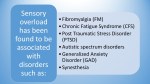
Sensory overload has been found to be associated with disorders such as:
Fibromyalgia (FM)
Chronic Fatigue Syndrome (CFS)
Post Traumatic Stress Disorder (PTSD)
Autistic spectrum disorders
Generalized Anxiety Disorder (GAD)
Synesthesia
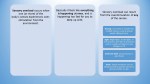
Slide 3: The text is in three pale blue rectangles that go horizontally across the slide. All use black text. The last rectangle has four smaller dark blue rectangles with white text inside it for the four points. The text is centred in all of the rectangles.
Sensory overload occurs when one (or more) of the body’s senses experiences over-stimulation from the environment.
Basically it feels like everything is happening at once, and is happening too fast for you to keep up with.
Sensory overload can result from the overstimulation of any of the senses.
Hearing: Loud noise or sound from multiple sources, such as several people talking at once.
Sight: Bright lights, strobe lights, or environments with lots of movement such as crowds or frequent scene changes on TV.
Smell and Taste: Strong aromas or spicy foods.
Touch: Tactile sensations such as being touched by another person or the feel of cloth on skin.
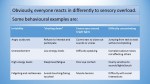
Slide 4: A heading in two light blue rectangles with black text, followed by a table with a dark blue first row that has white text, and then alternating pale blue and white rows with black text. (The table is not really a table, it is just a four-column list.)
Obviously, everyone reacts in differently to sensory overload.
Some behavioural examples are:
Irritability — “Shutting down” — Covers eyes around bright lights — Difficulty concentrating Angry outbursts — Refuses to interact and participate — Covers ears to close out sounds or voices — Jumping from task to task without completing Overexcitement — Low energy levels — Difficulty speaking — Compains about noises not effecting others High energy levels — Sleepiness/fatigue — poor eye contact — Overly sensitive to sounds/lights/touch Fidgeting and restlessness — Avoids touching/being touched — Muscle tension — Difficulty with social interactions
Slide 5: The header is in a dark blue box with pointy corners and white text. The body is in a pale blue box with pointy corners and black text.
There are two different methods to prevent sensory overload: avoidance and setting limits:
Create a more quiet and orderly environment – keeping the noise to a minimum and reducing the sense of clutter.
Rest before big events.
Focus your attention and energy on one thing at a time.
Restrict time spent on various activities.
Select settings to avoid crowds and noise.
One may also limit interactions with specific people to help prevent sensory overload.
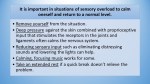
Slide 6: This looks the same as the last slide except the text in the header is black.
It is important in situations of sensory overload to calm oneself and return to a normal level.
Remove yourself from the situation.
Deep pressure against the skin combined with proprioceptive input that stimulates the receptors in the joints and ligaments often calms the nervous system.
Reducing sensory input such as eliminating distressing sounds and lowering the lights can help.
Calming, focusing music works for some.
Take an extended rest if a quick break doesn’t relieve the problem.
Slide 7: Four light blue rectangles with rounded corners, stacked one above the other, with black text.
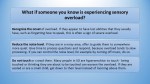
What if someone you know is experiencing sensory overload?
Recognize the onset of overload. If they appear to have lost abilities that they usually have, such as forgetting how to speak, this is often a sign of severe overload.
Reduce the noise level. If they are in a noisy area, offer to guide them somewhere more quiet. Give time to process questions and respond, because overload tends to slow processing. If you can control the noise level, for example by turning off music, do so.
Do not touch or crowd them. Many people in SO are hypersensitive to touch – being touched or thinking they are about to be touched can worsen the overload. If they are seated or are a small child, get down to their level instead of looming above them.
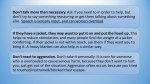
Slide 8: Similar to previous slide, only with three rectangles instead of four.
Don’t talk more than necessary. Ask if you need to in order to help, but don’t try to say something reassuring or get them talking about something else. Speech is sensory input, and can worsen overload.
If they have a jacket, they may want to put it on and put the hood up. This helps to reduce stimulation, and many people find the weight of a jacket comforting. If their jacket is not within reach, ask them if they want you to bring it. A heavy blanket can also help in a similar way.
Don’t react to aggression. Don’t take it personally. It is rare for someone who is overloaded to cause serious harm, because they don’t want to hurt you, just get out of the situation. Aggression often occurs because you tried to touched/restrained/blocked their escape.
Slide 9: Similar to previous slide, only with two rectangles instead of three.
When they have calmed down, be aware that they will often be tired and more susceptible to overload for quite awhile afterwards. It can take hours or days to fully recover from an episode of sensory overload. If you can, try to reduce stress occurring later on as well.
If they start self-injuring, you should usually not try to stop them. Restraint is likely to make their overload worse. Only intervene if they are doing something that could cause serious injury, such as hard biting or banging their head. It’s a lot better to deal with self-injury indirectly by lowering overload.
Slide 10: The header is in a dark blue rectangle with white text, and the other text is in a row of five dark blue circles with white text. The text is centred in all shapes.
To summarise – Remember the 5 R’s
Recognise The symptoms of overload
Remove Yourself from the situation
Reduce the stimulus causing the overload
Relax Your body and calm yourself down
Rest Yourself as you will most likely feel fatigue.]
This is important. I have sensory overload quite a bit actually. Most of the time it’s not too severe but sometimes it is.





 Kirkwall Was Totally Built On a Hellmouth