hackmydungeon:

I’m really excited to share this find!

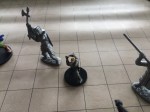
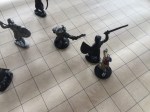
I found these treasures on Amazon, in a pack of 36. They’re small plastic knight figurines, with bases just small enough to fit in 1’ tiles. Perfect for D&D games!

They come in 6 different figures, with spears, swords, halberds, maces, and bows. Both grey and black in the pack.

They are a bit larger than the standard mini, but they make it easy to show larger hordes of enemies on the map.

They’re selling at $8.09 right now and you can order your own pack of 36 here: https://www.amazon.com/gp/aw/d/B000YA7FS6/ref=mp_s_a_1_fkmr0_1?ie=UTF8&qid=1474044146&sr=8-1-fkmr0&pi=AC_SX236_SY340_QL65&keywords=Toysmith+36-Piece+Guardian+Knights+Action+Figure+Set+https%3A%2F%2Fwww.amazon.com%2Fdp%2FB000YA7FS6%2Fref%3Dcm_sw_r_cp_api_Pcc3xb00S047G

Things this DM prefers to skip/ignore

dare-to-dm:

Time is valuable, and I prefer to use my game time focusing on things that are more interesting to the players as well as myself.  Especially relevant since I get less than 2 hours a week with one of my groups.

Experience points. You level up when I think it’s appropriate.

Calculating/dealing with how much money weighs. As far as I’m concerned all money exists in a convenient pocket dimension until you need it.

Inventory management for food/water.  I assume that you eat and drink when necessary, and stock up on rations when you’re able.  This only becomes relevant in extreme survival situations.

Going to the bathroom.  I personally don’t want to hear about it.

Inventory management for familiars. I assume you’re feeding the damn things and taking care of them in general.  I’m okay with players who roleplay their familiars constantly, but I also have nothing against familiars who only exist when they are needed pretty much.

Keeping track of ammunition.  Infinite arrows/bolts/bullets for all I care.  Unless they’re enchanted or otherwise special.

Ride checks for basic getting from Point A to Point B.  Unless you’re trying to go really fast or do something fancy, I assume you somehow work it out.  Or unless you’re trying to ride something exotic I guess.

Going through the whole Night Watch thing every night.  Early on I have players establish and normal night watch shift pattern, and I assume that is what they do unless they tell me otherwise.  So when we want to get back to the story quickly, I can just tell the players that they used their regular night watch and nothing of interest occurred. No bother having players describe setting up camp and everything.

Identifying common/basic magical gear.  You don’t have to roll spellcraft, appraise or use the Identify spell if it’s an item you’ve seen before.  I don’t want players to waste too much time figuring out what their loot is unless it’s specifically a mystery or something really high level and cool.

Confirming Criticals. This goes for both crit hits and crit misses.  This one is more of a personal preference, and I let the group vote on whether they want it or not.  One of my groups skips the step of confirming crits and I like it.  The exception is if you have a wide crit range and roll below a 20.  But on a 20 or a 1, something interesting always happens.

Anything you prefer to skip/gloss over?  Disagree with any of my choices?

bardicknowledgeblogger:

geekandsundry:

Matt Mercer is the master of cool who makes the rules. 

Watch him here: http://bit.ly/1VcaxDp 

This needs to be the like… mantra for every player and DM in d&d ever.

The DM makes the final call on the rules. And that means that the players need to remember that sometimes that call won’t fall strictly in line with how the rules are usually written or interpretted. And as for DM’s, they need to remember that sometimes, if a rule is going to inhibit a player’s ability to be creative or have fun, then the rule can (and should) be bent a little.

D&D should be a “Living Game” that adapts for every given scenario. Let the rules guide the growth of your game with your friends, not strangle it.

Character Creation

dare-to-dm:

Speaking of character creation, I got really sick of having players randomly roll up stats.  I found that most of my players fell into 2 camps with this process:

1) Yeah, I can’t believe I rolled three 18s at level one either!  Just lucky, I guess.

or

2) I keep dying because I don’t have any ability scores over 11 and I’ve only got 20 hitpoints at level 6.

Either extreme is frustrating for me to deal with as a DM.  So now I just give everyone the same array of stats at level one: 8, 10, 12, 14, 16, 18.

Experienced players will probably recognize those as being pretty heroic stats.  I like that array though, because it reins in the munchkin power gamers a bit, and ensures that everyone starts out with one dump stat and one stat at the highest.

Also it means I can plan for nice and challenging encounters, just the way I like them.  I also usually just automatically have all players gain 75% max hitpoints for their class when they level up.  I like big bad monsters, but killing a PC in one shot tends to dampen my fun.  

What are your preferences for character stat generation?

dare-to-dm:

@trevel

How do you run a session zero?”

A Session 0 is basically a meeting you have with your players before your campaign starts where you explain/discuss what your expectations for the game are going to be.  It’s a great way to get your campaign started off on the right foot.

So, for the campaign I’m about to run, I explained the concept of the campaign (fairy tale inspired story/setting) and outlined rules for creating their characters (CR 4, must not be humanoids, max HP, etc.).  

After discussing and approving various character concepts, I then asked my players to consider the following questions.

1) How did your character acquire an invitation to the king’s feast?  

2) Why have they chosen to attend?

Thanks to this meeting, I’ve now ensured that everyone has a character concept they’re happy with that fits well for the adventure.  And asking them to think of those backstory hooks ensures that they’ve created characters who will want to go on this adventure, which is also important.

It’s also a good time to explain any game mechanics/house rules/etiquette expectations with players who are unfamiliar with your style of gaming.