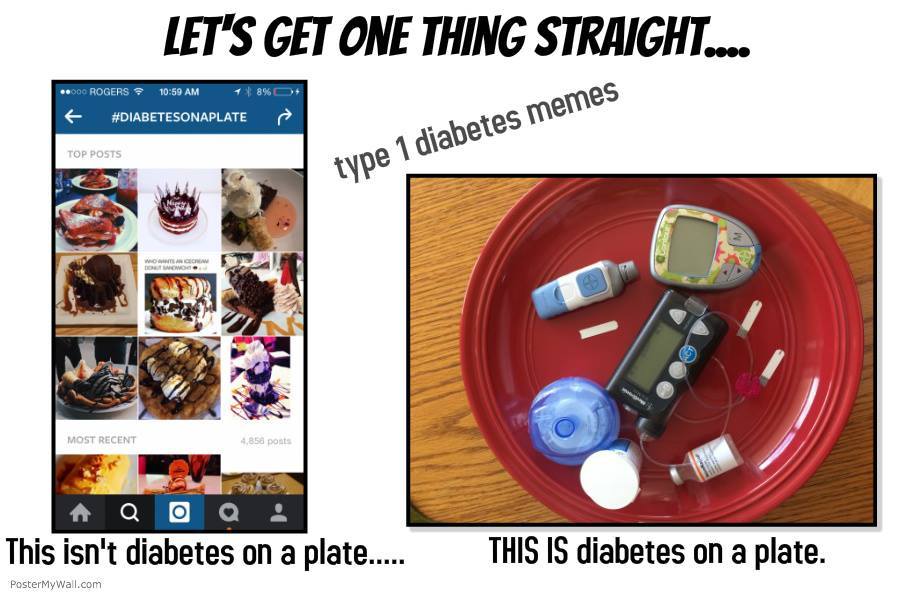
Tag: diabetes is not a punchline
“that just gave me diabetes”

Sweetly Voiced™: Snickers
This is a really good explanation of why those all too present “Bob/John/Joe/unlucky-name-of-the week has X amount of candy B; he eats Y amount. What does he have? Diabetes, Bob/John/Joe/unlucky-name-of-the week has diabetes” memes that tend to clog the diabetes tag which, guess what, people who actually have diabetes like to use, because it is a life-altering chronic illness that impacts most aspects of their lives.
My general mental response to those (besides blocking the tumblr user who posted one) is to immediately fantasize about tackling them and putting them in a headlock.
Note that I am attaching a content warning to this because it does reference rape jokes in order to point out that laughing about a disease that someone had no control over developing as if the person brought it on themself is a form of victim blaming.
“Diabetics shouldn’t have kids.”
“All of that sugar is why you’re diabetic to begin with”
“Constantly giving yourself shots is a disgusting way to live."

The "you did it to yourself by eating too much sugar” is one of the most hideous pieces of bullshit ever. 1) Shaming people for their diseases/conditions is disgusting and is, in a way, a form of victim-blaming. 2) There are are INFANTS who develop type 1 (see ten-day old with an insulin pump). I can assure you those babies have not eaten too much sugar. 3) Far, far too many other things that can be added.
Also, the one time in my life that I have literally seen red happened when, back in the days when I still thought I would someday want to carry a child or two, someone I no longer talk to online basically said, of the chance that any child I might produce might also develop diabetes, “Why would you want to do that to a child?” followed by some cutesy sad face emoticon.
It is well for both of us that we were separated by a computer screen and several hundred miles, as if she’d said that to my face I would probably have hit her as hard as I could.



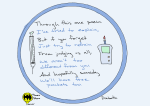
Don’t Be That Person: A Halloween PSA
One of the many Seasons of Copious Amounts of Sugary Treats (in this case, Halloween) is upon us.
With great amounts of candy comes a a great responsibility that most people don’t even realize is a responsibility.
That responsibility is to not be That Person who makes Halloween related diabetes jokes online or in real life.
It’s not cute.
It’s not funny.
And it’s not anywhere near factual.
Sugar does not cause any type of diabetes, no matter how much people want to use it as a way blame people for a disease that they have little to no control over developing. That’s right, little to no control. Even type 2 diabetes, the kind uninformed and insensitive people just love making fat jokes about, has more to it than just weight.
So this Halloween, don’t be That Person who makes “wise cracks” like “I ate sooo much candy I’m gonna get diabetes” or “I can taste the diabeetus.” Don’t be That Person who posts pictures of candy or other Halloween treats on Tumblr and tags the photos as “diabetes.”
Also, don’t be That Person who posts otherwise cute Halloween-y fandom things (or non-Halloween-y fandom things) and throws diabetes into a discussion of candy or into a discussion of how cute characters are or how cute characters are together.
Don’t do any of these things. They are cute. They aren’t funny. They’re hurtful and harmful and spread misinformation which adds to the stigma and the shame that often follows the word “diabetes.”
Millions of people all over the world deal with this chronic disease. There is no cure for type 1; insulin is only a treatment. Type 2 can sometimes be controlled by diet and exercise, but sometimes that alone is not enough.
People with diabetes are people, not punchlines.
So this Halloween? Don’t be That Person.
PICTURE OF CAKE TAGGED AS DIABETES

American Diabetes Month
November is a month chosen by many organizations to raise awareness about important issues. One of those issues that effects be personally is diabetes. I have been living with Type 1 diabetes for what will be 15 years this February. Diabetes is, unfortunately, one of the health issues that’s still largely in the dark of the mainstream cultural consciousness of the US, and probably other countries as well. It’s one of those health issues that often gets trotted out as the butt of jokes because of misinformation, or is seen as “not that serious” because, hey, “at least you don’t have cancer.” News flash: people can go into remission from cancer, and many can be cancer-free for many years after finishing their treatment. Diabetes is a disease you can control, but “control” is not “remission” and there is no cure for diabetes. Most diabetics will be dealing with this disease, in some way or another, until they die. So no, it’s not cancer, but it sure as hell isn’t somehow automatically a better alternative.
Here are a list of facts about the impact of diabetes from the American Diabetes Association:
About Diabetes
Prevalence
• Nearly 26 million children and adults in the United States have diabetes.
• Another 79 million Americans have prediabetes and are at risk for developing type 2 diabetes.
• Recent estimates project that as many as 1 in 3 American adults will have diabetes in 2050 unless we take
steps to Stop Diabetes.The Toll on Health
• Two out of three people with diabetes die from heart disease or stroke.
• Diabetes is the leading cause of kidney failure.
• Diabetes is the leading cause of new cases of blindness among adults.
• The rate of amputation for people with diabetes is 10 times higher than for people without diabetes.
• About 60-70 percent of people with diabetes have mild to severe forms of nerve damage that could result
in pain in the feet or hands, slowed digestion, sexual dysfunction and other nerve problems.Cost of Diabetes
• The American Diabetes Association estimates that the total national cost of diagnosed diabetes in the
United States is $174 billion.
o Direct medical costs reach $116 billion and the average medical expenditure among people with
diabetes is 2.3 times higher than those without the disease.
o Indirect costs amount to $58 billion (disability, work loss, premature mortality).
o Further published studies suggest that when additional costs for gestational diabetes, prediabetes and
undiagnosed diabetes are included, the total diabetes-related costs in the U.S. could exceed $218
billion.
• The cost of caring for someone with diabetes is $1 out of every $5 in total healthcare costs.
Now, there’s also a myth that, if you just “take good care” of yourself and have good control of your diabetes, that you won’t have any complications. This is, sadly, not always the case, because no matter how much a person with diabetes tries, things can go wrong even if you’re doing everything “right.” Sometimes your body just betrays you. That’s how it goes. That’s a lot of how diabetes happens in the first place: genetic predisposition generally plays a major role in Type 1, Type 1.5, AND Type 2. Environmental factors, including some types of viruses, also play a role, and there are also other things that can increase the risk of developing diabetes.
Having diabetes means you have, automatically, a higher risk of basically all the “big name” health problems, and it means you have a higher risk of depression.
Diabetes is serious. It’s not a death sentence, but it’s no walk in the park, either. It’s not a punchline for people who don’t have the disease to use to belittle those who do.
I’m disappointed in Jon Stewart for deciding that it was an awesome idea to attempt to shame bigots by shaming fat people and people with a chronic illness.
Type 2 diabetes, like all types of diabetes, is dependent on genetic predisposition. Many things can contribute to diabetes actually occurring; weight can be a factor, but it is not in itself a cause.
there seems to be some confusion on the diabetes tag so i wrote a helpful list of those who are allowed to decide whether jokes about diabetes are offensive, ignorant, rude, etc.
- people with diabetes
that’s it. that’s the list.
Seriously. And to anyone who sees this, you’ll probably want to avoid reading the reblogs.
Because a lot of them are chock full of assholes who think they get to decide what is offensive, and to whom certain things can be offensive, and to what degree anything can be offensive to anybody.
 Kirkwall Was Totally Built On a Hellmouth