Sameen “technically brilliant, a gifted doctor” Shaw needed to help translate instructions to destroy a deadly virus Harold probably got from the CDC.
Sameen “I probably read Snells and Grey’s cover to cover and all the other big assed expensive medical books” Shaw needed help translating Harold’s wordy instructions.
Sameen “hey, Finch how much do you know about chemistry and tagged team with Harold to create a big enough bomb to make a building go boom” Shaw needed help translating instructions to a deadly virus.
Sameen “I can McGuyver a smoke bomb from the contents of a high school chem lab in less than a minute” Shaw needed Root’s help translating instructions to destroying the virus.
Love when there are “how to tell if someone is lying/manipulating you” posts on my dash and 90% of them are things I do as an autistic person
Stuff like not making eye contact, wringing my hands, having a closed-off posture, having to control the tone of my voice, preferring to talk over the Internet… The whole damn list is just a huge presumption that if you don’t act “normal” then you’re lying
Like… Buddy. My whole childhood I got in trouble for things I didn’t do because I couldn’t make eye contact and I laughed at inappropriate times because that’s how my body decided to deal with fear. It wasn’t the greatest tbh
Although can we have a thing where a ~great detective~ accuses someone of being a murderer based on body language during an interrogation and then they’re like “I’m autistic, you fuck. This is just what I do! …Nice work being ableist and letting the real killer get away btw”
^^^This is so important. And as a criminologist, let me also add that body language is actually a TERRIBLE indicator of truth telling & deception.
Unfortunately, all of the research shows that using nonverbal behavior when trying to detect deception is not very useful.
If you doubt that claim, please see what all of the leading experts on the topic have to say (see Science News).
And using technology to detect deception isn’t as useful as people think it is (see ScienceDaily Report).
Why is it so difficult to detect deception by watching a person’s nonverbal behavior?
A detailed explanation is provided below or you can skip ahead to the next page and read why it is even more difficult to detect deception by a loved one (next page, catching lovers lying).
To begin with, there is some truth to the idea that people display or “leak” their genuine feelings when lying. But, these genuine displays of emotion—called “micro expressions"—last only a fraction of a second. As such, these expressions are too brief to be of much practical use (see facial expression test).
Furthermore, the nonverbal cues identified represent “on average” what might happen when studying many individuals rather than identifying what any specific individual is likely to do.
For instance, imagine that you have a group of 1000 men and a group of 1000 women, and you know that, on average, the men are 2 inches taller than the women. Now, say you find out that someone is 5’9”. Based on that information alone, can you tell with any certainty, if the individual in question is a man or a woman?
Why not?
The problem with “averages” is that it is difficult to use the information obtained from a large group to make claims back to any specific individual without a lot of other information. After all, there are tall women, short men and everything in-between. So, knowing someone’s height, by itself, does not really help solve the problem of trying to figure out if any given individual is a man or a woman (see Truth, Lies and Romance—provides a detailed example of this type of problem).
Second, the nonverbal cues that have been found are based on small statistical patterns—they are not strong, informative (diagnostic) differences.
This time, pretend that you have a large group of men and a large group of women. But, now the average height difference between the two groups is very small—say less than an half an inch. That half an inch may still be a statistical difference, but because the difference is so small, it is even less useful when trying to guess someone’s sex just by knowing how tall they are.
This is the same problem that occurs when using nonverbal cues to detect deception. The cues represent small, statistical differences between two groups rather information that can be used the other way around; that is, to distinguish liars from ts.
For example, some studies show that liars blink a few more times on average than truth-tellers (and not every study shows this). Now, say you notice that someone blinks several times while talking to you? Are they telling the truth or not? Who knows? To begin with, both liars and truth-tellers blink when talking (you are probably blinking right now)… And some liars rarely blink while some truth-tellers blink a lot… The graphs below show why the differences obtain are of little use when trying to detect deception…
Differences in Blinking Between Truth-tellers and Liars
So, in any given situation anything might happen, and the nonverbal cues that have been found ONLY emerge when looking at group averages.
Long story short, because only small statistical differences in detection cues have been discovered. It is very difficult to identify group members (liars versus truth-tellers) based on the cues that have been identified.
Most people, however, do not believe this claim.
Most people believe that nonverbal behavior can be used to detect deception. But, all the research shows that people no better than “flipping a coin” when trying to detect deception, especially when it comes to love and romance (see Miller & Stiff).
The nonverbal cues that have been identified are not useful because truth-tellers and liars are more similar in their behavior than they are different. And there are many reasons why the nonverbal differences identified are so small and of little practical use (see Fielder & Walka; McCornack).
First, many of the lies that people tell come naturally with no planning, thought, or effort. Lying is often automatic and effortless. Most people are not even aware of the fact that they are lying when they do it. Deception can come across as being “natural” because for many people it is natural.
Second, even if there is some stress or anxiety present when people lie—people typically tell the same lies over and over. Accordingly, people become very comfortable with their lies as time passes. In fact, people tell the same lies so often that they actually begin to believe what they are saying.
Finally, telling the truth can sometimes be just as difficult and stressful than lying. Have you ever been agitated, confused, anxious, or upset while trying to tell the truth only to have people doubt what you are saying? “High stake” situations are stressful for both liars as well as truth-tellers. In such situations, both liars and truth-tellers can get nervous and give off the appearance of telling a lie.
Or think about the problem this way: if detecting deception were so easy, everyone would do it and there would a lot few problems. Affairs, crime, and fraud are only possible because people, even trained professionals, have a difficult time detecting deception with any degree of success.
And, for the most part, people are even worse at spotting lies when dealing with someone they love… (source)
Sorry for the long response, this just NEEDS to be said & known. I’m very sorry this happens to you @medicationmambo bc it absolutely should NOT *hugs*
here’s the thing–the search will show you any post that contains the word. for example, if you used to track the tag for the anime free!, and now go to the most recent posts for free!, and it will show you any post that has ever mentioend “free!” which is, quite literally, a bunch of really shady posts and links and IRL nudity and totally irrelevant posts.
if you search for a ship you like, you will be subject to many hate posts for that ship. if you search for a fandom, you will have to scroll through every single post mentioning the name of that fandom.
you can still go to “/tagged/[tag-name]” (change it from search) but you cant track them
I HATE THIS SO MUCH. HATE IT. HATE IT HATE IT HATE IT.
me: ::attempts to go back to sleep after getting up to take meds::
my brain: actually, now is a perfect time to go over your complicated feelings about your gender/gender presentation and your complicated relationship to/feelings about your boobs and how you might handle that.
Asexuality is OFFICIALLY not a disorder, according to the APA.
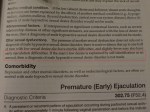
The images above are from the DSM-5, which is the latest edition of the American Psychiatric Association’s Diagnostic and Statistical Manual of Mental Disorders. The DSM-5 is a really important book. It is used by doctors and mental health care providers around the world to diagnose mental disorders.
The DSM-5 explicitly and clearly recognizes asexuality, and says that if a person is asexual, that they should not be diagnosed with Female Sexual Interest/Arousal Disorder or Male Hypoactive Sexual Desire Disorder.
This book says that you are valid, your feelings are real, and that you do not have a disorder because you feel this way.
Anyone who claims otherwise is wrong.
They do not know what they are talking about. You can point them at this book as proof that they are wrong.
Full Reference:
On page 434, in the section on Female Sexual Interest/Arousal Disorder (302.72), at the end of the “Diagnostic Features”, it reads:
If a lifelong lack of sexual desire is better explained by one’s self-identification as “asexual”, then a diagnosis of female sexual interest/arousal disorder would not be made.
On page 443, in the section on Male Hypoactive Sexual Desire Disorder (302.71), at the end of the “Differential Diagnosis”, it reads:
If the man’s low desire is explained by self-identification as an asexual, then a diagnosis of male hypoactive sexual desire disorder is not made.























 Kirkwall Was Totally Built On a Hellmouth