tsun-librarian-patchooooooooooo:
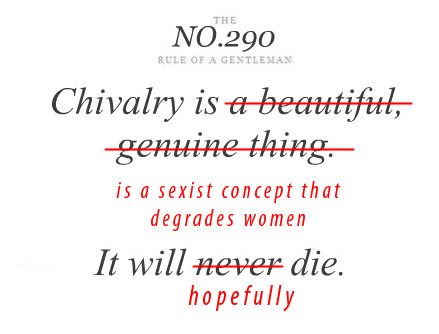
This, I don’t agree with.
In the past, to be chivalrous was to serve your king, to serve your God, and to serve all women.
We are now in an era where women don’t require special treatment, where kings hold no real power, and we are more free in our choice of religion.
However, the concept behind chivalry is not one to be laughed at.
It is the idea of putting others, regardless of their social status, before yourself, of protecting the weak and poor, of being loyal to your word, of courteousness, of mercy and yet of personal strength to me seems like a wonderful way to live your life.
It saddens me that if I were to hold a door for a woman they might be disgusted, thinking it were because of their gender. No, I look back every time I pass through a door and if I see anyone, I hold the door. It’s a kindness, not a discrimination.
Thank you. For God’s sake I can’t think of anything I hate more than women that will scream “gender discrimination” at virtually anything and everything. Politeness and common courtesy included.
I think chivalry has it’s merits and it’s faults, but everyone should incorporate it into their behavior to a small degree regardless of sex or gender.
Okay, here’s the thing, people. Chivalry began as one thing:
The medieval development of chivalry, with the concept of the honor of a lady and the ensuing knightly devotion to it, not only derived from the thinking about the Virgin Mary, but also contributed to it.[7] The medieval veneration of the Virgin Mary was contrasted by the fact that ordinary women, especially those outside aristocratic circles, were looked down upon. Although women were at times viewed as the source of evil, it was Mary who as mediator to God was a source of refuge for man. The development of medieval Mariology and the changing attitudes towards women paralleled each other and can best be understood in a common context.[8]
The basic idea of chivalry was to give people rules of behavior so that they would be loyal to their king no matter what, loyal to their God no matter what, and to treat women better. Basic, right?
But even the most basic of modern-day notions of chivalry are based on sexism in history. Men always had to pay in the past not because it was polite but because it was necessary; women, especially in high society, were completely and utterly dependent on the men around them for money. It sets a precedent of men as providers and women as dependents, and that sets it up as an unequal relationship. Why do we insist that we keep up this practice today, when girls and women are just as capable of having a job as a boyfriend? In today’s context, it cheapens her work because it says that despite the fact that she earned that money herself for her own use, she still has to depend on him financially because of her gender and because of tradition.
What about opening doors for women? Women were ‘scientifically proven’ to be the frail, weaker sex by scientists and philosophers for generations. Men were expected to open doors for them, to essentially take care of them because popular culture said (and still says to an extent) that she was not capable of taking care of herself. Again, it sets up the idea that women inherently need men to protect them, as if they’re not capable of opening their own damn door.
It’s one thing to be polite, people. If someone’s behind me, I don’t just slam the door behind me so they have to wait for me to move and then open it again. I hold it open so they can pass as quickly as possible. It’s polite to offer someone a coat if you think they’re cold and you’re really not. It’s polite to offer to help pay for a meal if you know someone can’t pay for it right now, whether or not they can pay you back later or help out some other way. That’s just part of being a good person, whether you’re male, female or otherwise.
But if you’re doing all of that based entirely on someone’s gender, you’re doing it with preconceptions of their goals, their preferences, and financial means, and that is sexism.
And finally, if we’re going to argue about the merits of chivalry, why don’t we argue about how part of it was to be absolutely loyal to a king until death? Or the whole part where you had to be a loyal Christian? If you’re going to support one part of it, why don’t you support the whole thing? Oh, right, because they’re also outdated and out of touch with how modern life really works.
No one ever brings those parts up, because they’re considered part of the past, something that shouldn’t be held to every man. So… why do we consider the other part of it to be? It baffles me.
There you go. NOW do you people get it?
I would like to add that most of what modern people think of when they hear “chivalry” is the version of the term embraced and altered by Victorian sensibilities. Chivalry originally was quite a bit more about being a chap who was well off enough to be able to afford to go into battle on horseback and have enough training to be good at it.
Also, those ladies they were supposed to treat right? That did not apply to Average Jane the Peasant, it only applied to Lady Jane of Castle Oddname. And, of course, only Lady Jane had a place in any of the French or English romances. And by romance I mean the old meaning of “exciting story in which fantastical things happen, and sometimes there might be kissing.”
Chivalry is not only sexist, it’s horribly classist.
Read Chretien de Troyes. Read Thomas Mallory. Their knights are not really that great as people. They’re great warriors, but they’re also kind of douchebags.You don’t get goody-two-shoes-‘I-must-angst-about-this-love-that-should-not-be’ until you get to Tennyson. And Tennyson at least bothered to have a system that shows that putting people on pedestals will bite you–and them–in the ass because people are only human.

 Kirkwall Was Totally Built On a Hellmouth